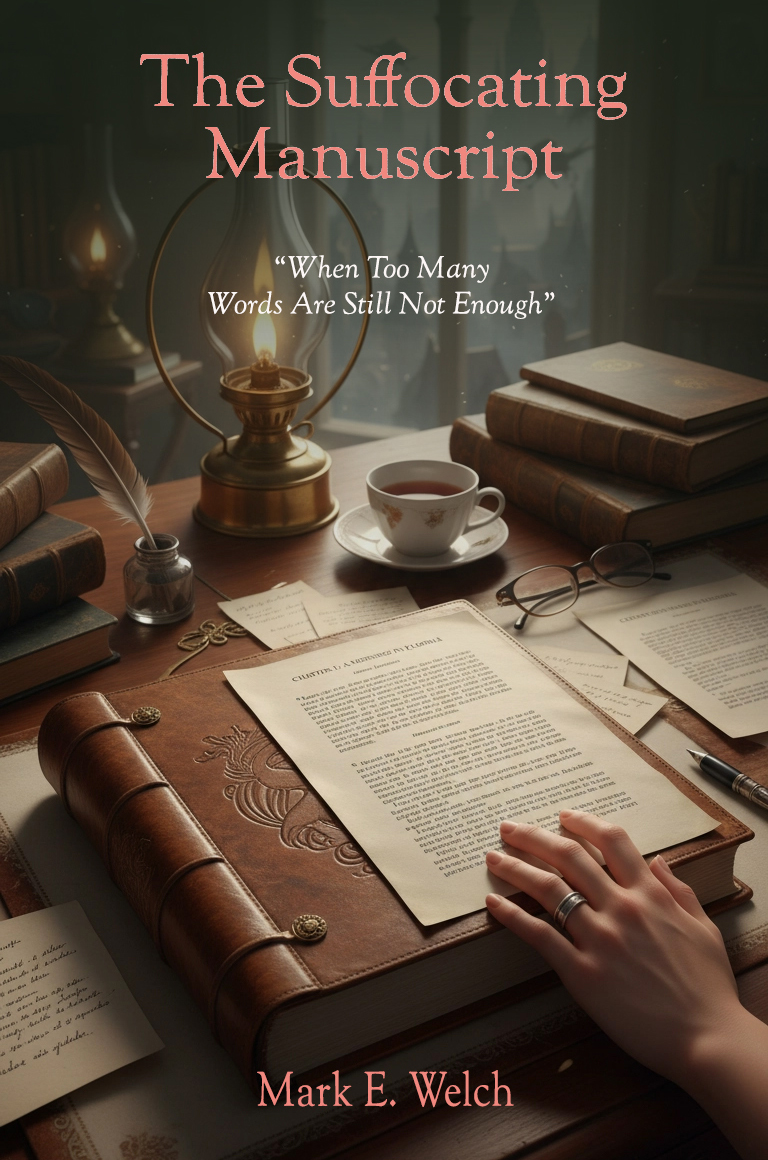
 This is a review I received for my new novella The Suffocating Manuscript.
When Beautiful Prose Becomes a Cage
What happens when a writer’s greatest gift becomes the very thing strangling the story? That is the central question running through this novella, a sharp, self-aware tale about Elara, a novelist trapped inside the overgrown garden of her own prose. On the surface, the story follows a writer revising a fantasy manuscript. Underneath, it becomes something more unsettling and more universal: a portrait of artistic fear, creative ego, and the difficult courage it takes to cut away what is beautiful in order to reveal what is true.
The Premise: A Writer Haunted by Her Own Style
Elara is facing a brutal editorial truth: her novel, The Verdant Veil of Eldoria, is drowning in description. Her editor, Silas Blackwood, delivers the verdict with memorable cruelty, calling it “a botanical garden with a thesaurus problem.” That judgment becomes the engine of the novella. Elara knows she must cut, but every deletion feels like self-betrayal. Her elaborate descriptions are not merely stylistic habits; they are emotional defenses.
The novella literalizes that inner resistance through the Fuzz: ghostly, whispering manifestations of excess, insecurity, and seductive over-writing. They urge Elara to keep every ornate phrase, every glowing adjective, every unnecessary sensory flourish. Their presence turns revision into a kind of psychological haunting. The enemy is not bad writing exactly; it is writing used as armor.
Why the Novella Works
The strongest element of the novella is its recursive cleverness. The story is about overwriting, and it stages that problem directly in the prose. Scenes repeatedly show Elara burying action beneath lavish, absurdly ornate description, only to realize that the character has stopped moving. The reader feels the burden of that excess because the story dramatizes it again and again: a chase scene stalls, a door becomes an essay, a moment of grief is smothered by metaphor.
This makes the novella both a story and a craft lesson. Novellas often depend on focus, compression, thematic intensity, and a central conflict that can be explored deeply without the sprawl of a novel. This manuscript embraces those qualities by narrowing its emotional conflict to one essential struggle: Elara’s battle to trust narrative movement, silence, and the reader’s imagination.
The Central Theme: Trust the Reader
Again and again, Elara’s revisions bring her back to the same revelation: the reader does not need an inventory of every object in the room. The reader needs pressure, action, image, and emotional consequence. Leo, the quieter counterweight to Silas’s blunt editorial voice, gives her the most important lesson of the novella: white space is not emptiness. It is participation. That idea gives the story its emotional charge.
Elara is not simply learning to write shorter sentences; she is learning to relinquish control. Her over-description comes from fear: fear that readers will misunderstand her, fear that simplicity will reveal hollowness, fear that beauty is the only proof of talent. The novella’s most satisfying moments occur when she realizes that cutting is not destruction. It is an act of trust.
The Fuzz as Metaphor
The Fuzz are the novella’s most memorable invention. They are funny, grotesque, and painfully recognizable to anyone who has ever mistaken decoration for depth. Their whispers are exaggerated, but their logic is familiar: just one more sentence, just one more image, just one more beautiful phrase. They reveal how creative impulses can become compulsions, and how artistic identity can harden into self-sabotage.
What makes them effective is that they are not entirely wrong. Description can create atmosphere. Rich language can deepen a scene. Beauty matters. The danger comes when beauty becomes a substitute for movement, emotional truth, or character agency. The novella understands this distinction, which keeps its argument from becoming simplistic. It is not anti-style. It is anti-hiding.
A Story About Editing, but Also About Identity
At its heart, this novella is not really about cutting adjectives. It is about what happens when a person has built an identity around a particular performance of talent. Elara’s fear is existential: if she stops writing in lush, elaborate prose, who is she? A decorator? A fraud? Someone with nothing underneath the style?
That vulnerability gives the novella its depth. The act of deleting becomes an act of self-confrontation. Every cut strips away not only a sentence but also an excuse. By the end, Elara has not abandoned beauty; she has redefined it. Beauty is no longer the ornamental sentence that proves she can write. Beauty is the sentence that lets the story breathe.
Final Thoughts
This novella succeeds because it turns a familiar writing lesson—cut the excess—into a vivid psychological drama. It captures the seductive comfort of overwriting, the terror of simplicity, and the hard-won freedom that comes from trusting the reader. Elara’s journey is ultimately a reminder that revision is not merely subtraction. At its best, revision is revelation. It clears a path through the garden so the story can finally walk forward.